Off the Pole
Core Exercises for Pole Dancing You Can Do at Home
/images/core-exercises-pole-dancing-at-home.jpg and drop an <img class="pp-hero"> tag right above the lead paragraph once you have it.Every trick that looks effortless on the pole — a controlled invert, a still handspring, a spin that doesn't wobble — is powered by a core that can resist rotation, control your spine, and hold your hips exactly where you put them. That strength isn't built by wishing for it on the pole; it's built on the floor, between sessions. Here are eight classic, well-known core exercises — no invented names, just the moves you'd find in any solid strength program — mapped to what pole dancing actually demands.
No pole, no equipment — just a floor and a bit of space. Treat this as the quiet work that makes your inverts stop swinging and your holds stop shaking.
Why "core strength" means more than abs
Your spine has to stabilise in four directions: it can bend forward (flexion), arch back (extension), bend sideways (lateral flexion), and twist (rotation). Pole dancing asks your core to resist all four, often at the same time — spins throw rotational force at you, inverts demand controlled flexion, and holds test your ability to stay rigid under load. A routine that's all crunches only trains one of those four directions, which is why this list is spread across the full set.
How to use this routine
Run through all eight moves as one circuit, two to three times a week, on days you're not poling hard. Rest at least a day between sessions. Keep your reps a notch below failure so your form stays clean — a sloppy rep trains the wrong pattern.
Before you start
Warm up your spine and hips for a few minutes first: cat-cows, hip circles, a gentle twist or two. A cold core is a stiff, cautious core — and this routine works best when you can move through full range.
The 8 moves
Dead Bug
Anti-extensionLie on your back with arms reaching toward the ceiling and knees bent at 90 degrees, shins parallel to the floor. Press your lower back gently into the floor and keep it there as you lower one arm overhead and extend the opposite leg out straight, hovering just above the ground. Return to center and switch sides.
Pole transfer: This is the exact skill an invert needs — moving your limbs while your spine stays completely still. If your lower back lifts off the floor here, it'll arch on the pole too.
Regression: Move only the legs first, keeping arms reaching toward the ceiling throughout.
3 × 10 per side
Reverse Crunch
Lower absLie on your back with knees bent and lifted toward your chest, hands flat on the floor by your sides for support. Curl your hips up off the floor toward your ribcage, then lower with control — think of curling your hips upward rather than swinging your legs.
Pole transfer: This is the low-ab strength and hip control that keeps your legs from flailing the moment you lift off the floor into an invert.
Regression: Reduce the range of motion — a small, controlled hip curl still counts.
Progression: Slow the tempo down, taking 3–4 seconds to lower on each rep.
3 × 12 reps
Bicycle Crunch
ObliquesLying on your back, lift your head, neck and shoulders off the ground with knees at tabletop. Pull one knee toward your chest and extend the other away, rotating to bring your opposite elbow toward the bent knee. Switch sides in a smooth, controlled pedalling motion.
Pole transfer: Controlled rotation under load is what keeps transitions and spins clean instead of twisty and rushed.
Regression: Slow the pace right down and focus on the rotation rather than speed.
3 × 20 (10 per side)
Russian Twist
RotationSit with knees bent, lean back slightly to a 45-degree angle, and lift your feet off the floor (or keep heels down if you're building up to it). Clasp your hands together and rotate your torso to tap the floor beside one hip, then the other, keeping your spine long rather than rounded.
Pole transfer: Spinal rotation is central to spins and many transitions — this is one of the most direct ways to build the strength behind them.
Regression: Keep your feet on the floor and cross your lower legs for extra stability.
Progression: Hold a light weight or a water bottle between your hands.
3 × 16 (8 per side)
Side Plank
Lateral stabilityLie on your side, prop yourself up on your forearm with your elbow under your shoulder, and stack your feet. Lift your hips until your body forms a straight line from shoulders to ankles. Hold, keeping your hips lifted and square rather than rolling forward or back.
Pole transfer: Builds the lateral core stability that shows up in brackets and any move where your body hangs off one point of contact.
Regression: Stack your knees instead of your feet to shorten the lever and make balance easier.
3 × 20–30 sec per side
Side Plank Hip Dip
ObliquesStart in the same side plank position. Dip your bottom hip toward the floor under control, then press it back up to the straight-line position. Keep the movement small and controlled rather than dropping and bouncing.
Pole transfer: Adds a dynamic, moving element to the static side plank, closer to how your obliques actually work during spins and transitions.
Regression: Reduce the range of the dip until your shoulder feels stable throughout.
3 × 10 per side
Bird Dog
Anti-rotationStart on all fours, hands under shoulders and knees under hips. Extend one arm straight ahead and the opposite leg straight behind, keeping your hips and shoulders square to the floor rather than tipping to one side. Hold briefly, return to center, and switch sides.
Pole transfer: This is the same rotational force pole spins constantly throw at your body — training your core to resist twisting keeps your lines clean instead of collapsing.
Regression: Extend just the arm or just the leg on its own until the full combination feels stable.
3 × 8 per side
Forearm Plank
Full coreForearms down, elbows under shoulders, body in one straight line from shoulders to heels. Brace your glutes and abs and breathe steadily rather than holding your breath.
Pole transfer: The foundational anti-extension strength underneath every other move on this list — if your plank sags, everything built on top of it will too.
Regression: Drop to your knees, keeping the same straight line from shoulders to knees.
3 × 20–40 sec hold
Putting it together
A full pass of all eight takes around fifteen to twenty minutes. Anti-extension work (Dead Bug, Forearm Plank), lower-ab strength (Reverse Crunch), rotational control (Bicycle Crunch, Russian Twist, Bird Dog), and lateral stability (Side Plank, Side Plank Hip Dip) — that covers every direction your spine needs to stabilise on the pole. Track your numbers and add a rep or a few seconds most weeks.
A note on consistency
Nobody feels a difference after one session. Four to six weeks of showing up two or three times a week is when it clicks — your legs stop swinging in inverts, your spins stay controlled, and holds that used to shake start to feel steady. Strength is built, not born.
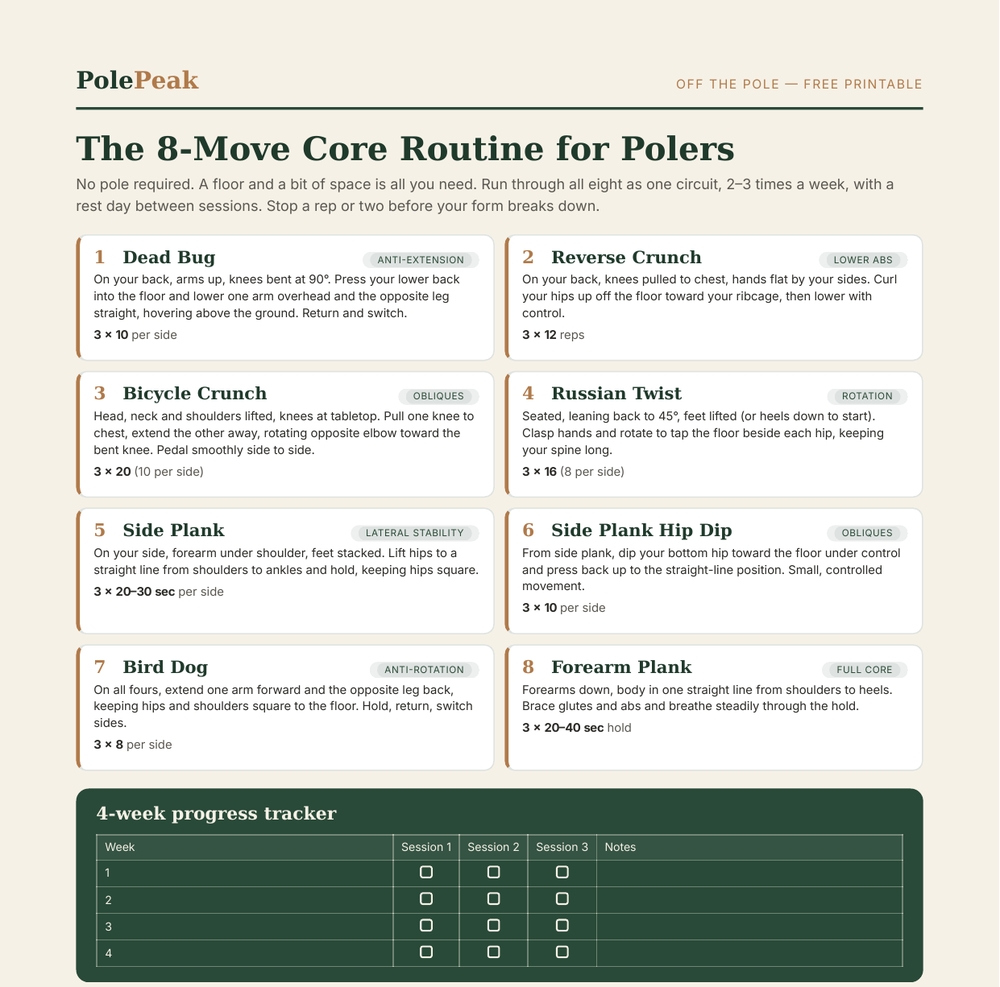
Free printable
Get the routine as a printable PDF
The full 8-move circuit on one page, with a 4-week progress tracker. Enter your email and we'll unlock the download — you'll also hear from us once when the Pole Peak app launches.
No spam. Just the download, plus one additional email when the app launches.
Frequently asked questions
Do I need a pole to train my core for pole dancing?
No. All eight exercises here only need a floor and a bit of space. They build the same core patterns — anti-rotation, controlled spine movement, and low-ab strength — that pole tricks demand.
How often should I do core exercises for pole dancing?
Two to three times a week is enough, ideally on days you're not poling hard or the day after a big session. Give yourself at least one rest day between core sessions.
Why is core strength so important for pole dancing?
Pole moves constantly ask your core to resist rotation, control your spine through inversions, and hold your hips and legs in position while your hands or a single point of contact do the gripping. Weak core strength shows up as swinging legs, sagging holds, and instability in transitions.
Can I do this routine alongside the general conditioning routine?
Yes — they're designed to complement each other. The general conditioning routine covers push, pull, grip and posterior chain, while this one goes deeper on the specific core patterns pole dancing needs. Alternate them across the week rather than doing both back to back.
Ready to take it to the pole?
Browse the Moves List and find your next move to work toward.
Explore the Moves ListStrength is built, not born.